Photographer Samuel Elkins runs a popular youtube channel, and he recently purchased the Fujifilm GFX100.
He comes from full frame Canon, so his expectations where high, especially in terms of colors.
In the video, he goes over 4 images that he imported in Lightroom.
First he noticed that, when he turns the exposure sliders, the images “react so well” and he has never seen his Canon files react that good. He concludes that this is probably because the “image quality is off the charts. I think a lot has to do with the 16bit color depth.” on the GFX100.
He edits his images for about 20 seconds, but then remarks:
I want you guys to notice, how good it looks, just right out of the camera. Great skin tones. Great dynamic range. Great colors.
Overall he seems to experience what many Fujifilm shooters are already familiar with: faster image editing thanks to the great Fuji files out of the box.
At the end it is a split decision, with Anete preferring the Fujifilm system and Sonder Creative the Sony system.
But I want to highlight one thing, before I leave you to the video and a summary down below.
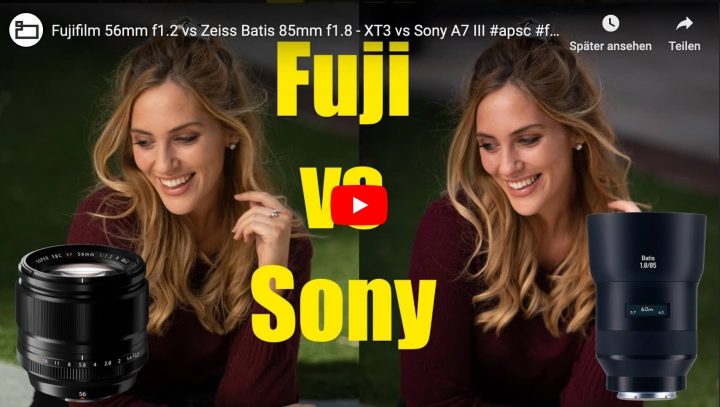
We know that, in terms of depth of field, f/1.2 on APS-C does not give the same results of f/1.2 on full frame.
In fact, f/1.2 on APS-C is closer to f/1.8 on full frame, and this is why on this comparison you don’t really see any difference in terms of depth of field between the Fuji and the Sony (except for the bokeh quality, which is better on the Fuji.)
The point?
When Sonder Creative exposed properly both images (base ISO, and widest aperture), he noticed that the shutter speed was completely different:
FUJIFILM: ISO 160 – f/1.2 – 1/8000
SONY: ISO 100 – f/1.8 – 1/3200
He concludes saying that:
one of the advantages of shooting with APS-C, is that you can shoot with a much faster shutter speed compared to full frame
Seen from this perspective, the light gathering capability of f/1.2 on Fujifilm APS-C is and remains f/1.2.
I thought I point this out and let you discuss about it.
Notice how that they mostly focus on shooting experience, rather than pixel peeping. And honestly that’s kind of refreshing, as we usually are bombarded with charts, crops and comparisons when a new camera comes out.
Seen from this perspective, the Fujifilm X-Pro3 already achieved what it’s ment for: focus on feel and experience, rather than technical specs.
In case of Gordon (Cameralabs), he says the hidden screen helped him to review images and access menus way less than he normally does. He says:
Previously I always preferred the X-T series over the X-Pro series. But with the X-Pro3 I was surprised just how refreshing and enjoyable I found the experience, how little I worried about settings or features and how much I’d like to shoot with it again.
The Features
With that said, of course the reviewers also go over the new features of this camera.
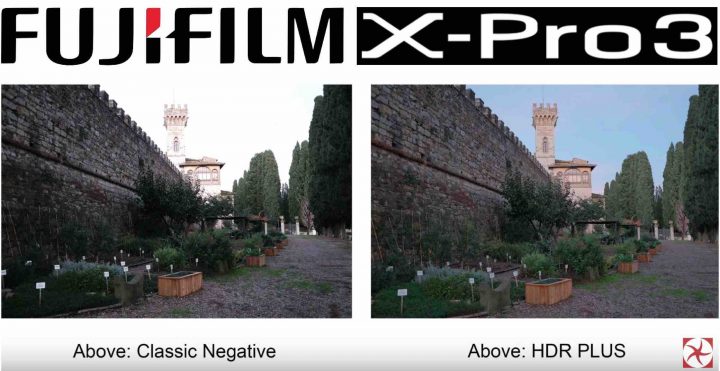
For example, Gordon from Cameralabs shows samples of the new HDR plus mode, a feature that Gordon says “makes a really good job”. Press the shutter once, and the camera takes three images and combines them into one HDR image (see images below). It works used handheld.
Oh… and Gordon LOVES the new Classic Negative film simulation.
Now let’s cross fingers that all the X-Pro3 firmware goodness on the X-T3, X-T30 and GFX100.
As you know, the optical viewfinder on the “old” X-Pro2 had a build-in 0.36x and 0.60x magnification modes. So, when you use let’s say a 35mm lens, in order for your frame not be too small in the viewfinder, you could switch to the 0.60x magnification.
This is no longer possible with X-Pro3, as it has a fixed OVF magnification of 0.52x.
However, Gordon says that the overall much bigger optical viewfinder on the X-Pro3 helps to compensate for the lack of 0.60x magnification.
For your convenience, down below I have extracted and overlayed both viewfinder frames at 23 and 35 so you get a clear idea how big the difference really is.
With all that said, check out the Fujifilm X-Pro3 review roundup below.