Skip to content

How Many Cameras and Lenses Does Fujifilm Release Every Year? And What it Could Mean for 2026

2026 – A Big Fujifilm Year?

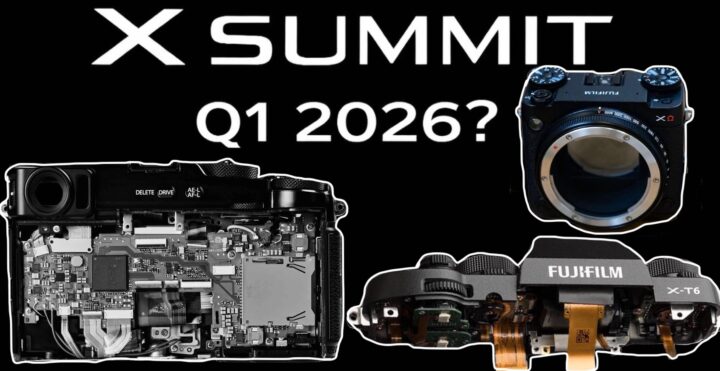
2026 could potentially be a huge year for Fujifilm. Fujifilm is going to start to upgrade their cameras to the 6th generation platform.

But how many cameras – and also lenses – can we expect to get in 2026?

Well, let’s take a quick look at how much gear Fujifilm announced in the past years.

Gear released in 2025 – 4 cameras and 3 lenses

Gear released in 2024 – 4 cameras and 4 lenses

Gear released in 2023 – 2 cameras and 4 lenses

Gear released in 2022 – 3 cameras and 4 lenses

Cameras in 2026

So, will there be more than just the two already rumored cameras in 2026?

If we look at Fujifilm’s history (not a rumor), the answer is very likely: yes.

As you can see above. Fujifilm rarely limits itself to just two camera announcements in a year—especially when a new generation of technology is involved. A platform transition usually triggers a cascade of releases, not just a single camera.

If 2026 is truly the beginning of the 6th-generation era, then what we already rumored could just be the tip of the iceberg.

And if Fujifilm maintains the pace it set in 2024 and 2025, there could be 2 more cameras in addition to the ones we already rumored.

It’s your time to guess what else could come ;).

Lenses in 2026

Fujifilm has quite consistently released around four lenses each year, combining both X and GFX series models, except for 2025, when we got 3 lenses.

So far I have no rumors about future lenses, which means you have three/four slots you can fill in with your wishes. :)

Let’s Make it an Awesome Rumor Year :)

If anyone out there can maybe give us a hint on future X and GF lenses, feel free to reach out to FujiRumors. Your help would be greatly appreciated.

Overall, 2026 remains a significant mystery, but I’m hopeful that our trusted sources (and maybe some new ones) will be able to shed light on some of the unknowns and provide insights that will make us even more excited for what’s to come.

Until then, keep shooting, keep enjoying life… and every now and then, keep checking in on FujiRumors ;).

Fujifilm X half Deal Extended – and More Fujifilm Rebates

Fujifilm has extended the $200 discount on Fujifilm X half until March 1.

Unofficial XF Lens Deals – unknown ending date

Official XF Lens Deals – end January 18

Official X Camera Deals – end January 18

Official GFX Gear Deals – end January 18

* freebies at BHphoto include a free CFexpress Type B Card and a camera bag

SUPER-SURVEY: What Fujinon X Mount Lenses do You Own – Third Party AF Lenses Included

Back in August, I launched a survey asking you which Fujifilm X camera you own (results here).

Some of you then challenged me: “What about a lens version?”

It sounded insane — the amount of work needed would be ridiculous.

So naturally… I did it. :)

The survey covers every Fujifilm X-mount autofocus lens I know of that’s currently on the market — Fujinon and third-party alike.

Now I’m really curious to see whether you guys mostly stick with Fujinon lenses, or if some third-party options can sneak their way into the top spots.

So guys… I’ve done my part and put the effort into creating the survey — now be kind and do yours: cast your vote! ;)

VOTE

** CLICK HERE to Read the Rest of the Article **

Up to $500 Off X-H2/S Bundles, XF 8mmF3.5 Rebate Increased to $300, Last Hours for X half Deal

BHphoto is now offering an up to $500 rebate on the Fujifilm X-H2/S bundles:

Also, BHphoto increased the rebate on the XF8mmF3.5 to $300 (previously $250 off).

These are just some of the BHphoto exclusive Fujifilm, which are not part of the official Fujifilm deals.

Also, the $200 discount on Fujifilm X half will end today!

Unofficial XF Lens Deals – unknown ending date

Official XF Lens Deals – end January 18

Official X Camera Deals – end January 18

Official GFX Gear Deals – end January 18

* freebies at BHphoto include a free CFexpress Type B Card and a camera bag

The Internet is Grading Fujifilm in 2025 – And These are My Votes

With 2025 basically over and the internet is grading the Fujifilm year 2025.

For example, in a lengthy podcast, these are the grades of the PetaPixel team:

  • Jordan: B-
    lots of repackaging of same tech. He likes X half concept, but not the camera. AF needs to improve
  • Chris: B-
    no new lenses (admin note: that’s not correct). Autofocus has to improve
  • Gordon: A
    a lot of releases in different formats. Squeezing last drops out of 5th generation. His guess: next year X-Pro4 will introduce new sensor
  • Jaron: A
    Jaron agrees with Gordon. We got LUT’s. X half deserves praise for a company trying something different.

Fuji X Weekly graded every single release:

  • GFX100RF: A+
  • X half: B-
  • X-E5: A
  • GFX Eterna 55: A-
  • X-T30 III: B+
  • XF23mmF2.8: A-
  • XC13-33mm: C
  • GF32-90mm: A

Overall he gives it a B ranking.

And my votes?

I’ll rank it from best to worst.

  • X-E5: A++++++…. taking a breath+++++++++++

I might be biased… or maybe I am not? ;) It’s the most enjoyable Fujifilm camera I have ever used. Looks great, feels great, I love the film sim dial, trusted 40MP X-Trans V image quality. It’s my all-time favorite Fujifilm camera to date.

I own the XF27mmF2.8, which is awesome. But the XF23mmF2.8 from an image quality point of view is even better. Wonderful little lens

It makes a whole lot of sense that Fujifilm released a medium format version of the X100, and they did a great job. Some might want IBIS, a faster lens etc, but then you don’t get the compact size. And in my opinion Fujifilm did well to prioritize size, especially considering the massive flexibility of the GFX files.

So often I have seen people complaining Fujifilm does not care about affordable entry level, that everything is too expensive. Well, this lens addresses this huge criticism, and it does it with an astonishing image quality.

Again, this addresses the complain of the lack of entry level cameras with EVF in the Fujifilm ecosystem. Keeps the loved X-T30 form factor with X Processor 5 boost.

The price is simply too high—on that, I think we can all agree. The concept itself may also be a bit too experimental for some, and that’s a fair criticism.

Still, I will always applaud Fujifilm when they dare to do something different in an otherwise increasingly monotonous camera market. This is their way of trying to offer a genuinely different photographic experience. Sometimes it works, sometimes it doesn’t—but at least Fujifilm is willing to try.

The X Half itself is highly divisive—some love it, others don’t. I haven’t had the chance to shoot with it yet, so I can’t pass final judgment, but there are definitely some features that intrigue me.

Well, I guess it’s a good lens for filmmakers, maybe even a stunning lens. So the “C” is not for the lens itself, but for the need of such a lens: are there really so many filmmakers shooting GFX out there?

I said I am worried…. and I still keep being worried about this project, especially since, unlike I hoped, I don’t see any benefits trickle down for other X/GFX cameras. Nothing wrong with the camera itself, but it looks like an R&D resources killer.

And You?

You voted your best and worst 2025 gear here (third party AF lenses included).

Fujinon 35mm F4 and 28mm F4 Patents Spotted

Two patents showing a Fujinon 35mmF4 and 28mmF4 lens for a format “larger than full frame” have now surfaced and reported about at the Japanese website Asobinet.

These are patents very likely for a fixed lens GFX camera.

We remind you the Fujifilm GFX100RF features a 35mmF4 lens. Maybe you’d have prefered a 28mm lens?

** CLICK HERE to Read the Rest of the Article **

Sony DGO vs DCG Sensor – The Pros and Cons – And What Would You Like on Fujifilm’s 6th Generation Cameras? – VOTE

DGO vs DCG

After our in-depth article on Sony’s new DGO sensor, other websites have finally started to pick up the topic.

But their coverage is still incomplete — missing key details (and some serious drawbacks) that photographers absolutely need to understand in order to use this new technology to its full potential.

Why these points are being glossed over is unclear, especially since they’re crucial for Sony A7V users who could unknowingly lose up to 1 stop of dynamic range compared to the older A7IV if they’re not careful.

So let’s break down the pros and cons in a quick overview. And if you haven’t yet, give our main article a read — it clearly explains the difference between DGO (Dual Gain Output) and DCG (Dual Conversion Gain), which is essential to understanding this debate.

DGO advanatges

  • Excellent dynamic range at low ISO

DGO limitations/downsides

  • No DR benefit above ISO 400/500
  • No DR benefit at all with electronic shutter
  • Up to 1.5 stops DR loss with e-shutter compared to mechanical shutter
  • the old Sony A7IV gives you about 1 stop more dynamic range than the brand new Sony A7V between ISO400-800 if you use electronic shutter, because on the A7V dual gain kicks in only at ISO1000 (vs ISO400 on A7IV

So, just be aware that there is no DR benefit when using electronic shutter and if you use ES in values between ISO400 and ISO800, you actually lose 1 stop of dynamic range over the older Sony A7IV

The Fujifilm Sensor Future

Sony is not keeping this technology to themselves.

In fact, the first mainstream hybrid camera to use a Sony DGO sensor wasn’t a Sony at all — it was the Panasonic S1II.

And since that sensor is already available on the market, I see no reason why Fujifilm couldn’t buy and use it as well.

So the real question becomes: what would you prefer for Fujifilm’s 6th-generation cameras — a DGO or a DCG sensor?

If you rely heavily on the electronic shutter, DGO might actually work against you. In the best case you get no benefit at all, and in the worst case you could lose up to 1 stop of dynamic range at certain ISO values.

But considering that high-end Fujifilm APS-C bodies already reach (for now) 15 fps with the mechanical shutter (compared to Sony’s 10 fps), the need for electronic shutter bursts is far lower on Fujifilm cameras anyway.

Personally, I’d be happy with either. I’m already “cheating” dynamic range via DR200/400, so both systems work for me. But if I had to choose, I’d take DGO if that still gives me access to DR200/400 — especially on GFX, where it could allow even higher pixel densities and higher base dynamic range, turning it into the ultimate high-resolution / high-DR platform.

My prediction?

I would not be surprised if DGO would soon become the industry standard. Nikon, OM System, Canon, Fujifilm — everyone will adopt it sooner or later.

But enough from me — let me know what you prefer by voting in the poll below.

I want Fujifilm's 6th generation GFX cameras to have a...

View Results

Loading ... Loading ...

I want Fujifilm's 6th generation APS-C cameras to have a...

View Results

Loading ... Loading ...

How Sony Is Rewriting Dynamic Range Sensor Performance (DGO vs DCG) — And the Hidden Drawbacks You Need to Know

Dual Conversion Gain (DCG) – The “Old” Tech

First things first: what exactly is Dual Conversion Gain?
Modern camera sensors — Fujifilm included — operate in two modes:

  • Low conversion gain: used at lower ISO values
  • High conversion gain: activated automatically at higher ISO values (for example, ISO 500 on the GFX100 II)

Let’s look at the Fujifilm GFX100 II dynamic range data using Photons to Photos data:

  • ISO 400 → 10.49 stops DR
  • ISO 500 → 10.91 stops DR
  • ISO 640 → 10.62 stops DR

Why does dynamic range increase at ISO 500 and ISO 640 compared to ISO 400?

Because that’s the point where the camera switches into high-gain mode, which reduces read noise and produces a DR “bump.”

For years, this dual conversion gain jump was the key method to maximize sensor performance.

But that changed—recently, and dramatically—with the launch of the Panasonic S1II first, and now also with the Sony A7V.

Dual Gain Output (DGO) – The New Tech

With the Panasonic S1 II (Sony-made, partially stacked sensor) and now the Sony A7 V, something unusual appeared in the data:

** CLICK HERE to Read the Rest of the Article **

Fujifilm Holiday Savings: What Deals Expire December 28 vs. What Lasts Until January 18

Some of you have asked when the current Fujifilm X and GFX holiday savings will expire. Here’s the quick overview.

Most of the Fujifilm deals are running well into the new year and will officially end on January 18.

However, there is one exception you should be aware of: the $200 price drop on the Fujifilm X half is only available until December 28.

Fujifilm went super-aggressive with the GFX deals thanks to an up to $1,000 rebate which is even made better by the addition of a free CFexpress Type B and camera bag only at BHphoto.

The Top Deal – save $1,000 + Free CFexpress Type B card and Camera Bag

X Cameras

X Lenses

GFX Gear

* freebies at BHphoto include a free CFexpress Type B Card and a camera bag

Instax Gear

Fujifilm X half – save $200
BHphoto / Amazon US (blackcharcoalsilver) / Adorama / Moment / Nuzira/ BestBuy / Paul’s Photo

Viltrox AF 9mmF2.8 Air Reviews Roundup

The announcement of the Viltrox AF 9mm f/2.8 Air passed a bit under the radar due these days, due to the plethora of other news and rumors we have shared.

Now that it’s a bit more quiet, let’s take a closer look at it thanks to new reviews, that I will share down below.

The Viltrox AF 9mm f/2.8 is available for other mounts already since a while and so far it enjoys fantastic reviews: