French Fujifilm managers gave an interview to the French website Phototrend. Here is the summary:
Market Share
12% of the market share in value of APS-C sensor hybrids
Including compacts like the GFX 100RF and X100VI (the best seller), Fujifilm reaches about 13–14% of the French global photo market
Excellent dynamic, Fujifilm is progressing in each segment
Fujifilm wants to become Nr.3 on the market
Since Nikon is currently the No.3 brand, Fujifilm France aims to surpass them. And, as we’ll see below, the Fujifilm X-E5 appears to be leading that charge in 2025.
Fujifilm X-E5 Sales and About Taking Risks
X-E5 has clearly been biggest success of the last 12 months
Fujifilm is offering a wide range of cameras, from X half to X-H2S, catering to different needs and budgets for young smartphone photographers seeking an upgrade
GFX100RF sales far beyond expectation. A great start and now sales stabilized but is curve remains healthy
X100VI still not that easy to find, although some retailers have stock
X half is a bet, a new concept. For generations used to vertical format
Instax Pal failed in Europe. But you have to innovate and try some risks. Sometimes it will work, sometimes not
The GFX Eterna 55 combines this optical expertise with a cinema ambition. Fujifilm targets short movies productions with cinema quality
The €1500–€2500 hybrid segment is saturated, so the challenge is to either move toward more accessible models like the X-M5 or elevate the offer with tools like Eterna
Instax cameras that let users preview photos before printing haven’t reduced film sales—people now print only their best shots, and they often print it multiple times to share with others
Increasing Prices
price has increased and except for X-M5 there is no sub-1K camera anymore
second hand prices are under 1K, it’s a great, sustainable and ecological alternative
Third Party Lens Bundles
retailers can sell XF23mmF2.8 as a kit with other Fujifilm cameras
the only thing Fujifilm wants to make sure of, is that retailers do not bundle third party lenses with Fujifilm cameras
A few months ago, we estimated—based on Fujifilm’s historical sensor/processor refresh cycles—that the next sensor generation would likely arrive in late 2025 or early 2026.
To be clear, that wasn’t a rumor, just a data-driven speculation.
Following that article, some speculated that November 2025 could be the right moment, since Fujifilm has historically launched some of its most important cameras in that month (such as the X-T5).
But today I can confirm: the 6th generation platform will not be launched in 2025. So you can now rule out “late 2025” as a possibility.
That also means we won’t see the Fujifilm X-T6, X-Pro4 (or X-Pro5, X-Pro6), X-H3, X-H3S, X-T60, X-E6, X100VII, GFX100III, GFX100SIII, or GFX100RFII this year.
And yes, I know plenty of supposed “spec leaks” about these cameras are floating around—but they’re all fake, as we explained here.
Bottom line: it’s all AI-generated nonsense, stuffed with random specs. Every day there’s a new “upcoming” Fujifilm camera announcement.
Some of these videos gather tons of views and lots of comments, so I want to stress it once more: it’s fake.
And yes, I sometimes feel like a lonely Don Quixote, tilting at the windmills of fake rumors with little hope (illusion) of winning this battle. But what matters is staying true to yourself and bring excitement in the Fujifilm community only when it is real, verified, and worth celebrating. So I’ll leave the fake rumors to others. Shall they boost their traffic and make money by misleading people with all sorts of fake rumors. We’ll stay out of this game.
Anyway, the wait for the Fujifilm X-T6 and friends might be a bit longer than we’d like, but it’s much easier to stay patient when you’ve got the ultra-awesome Fujifilm X-E5 in your hands ;)
The X-T4 IR might not have had the longest life span, but it will go down with a clean 5 star rating, thanks to one person who bought and gave it an excellent review :).
No wonder that therefore I also get many emails from X-T5 owners asking me all sorts of questions. And one question that comes up quite regularly is which UHS-II SD-Cards I recommend for the Fujifilm X-T5.
*1 Model name could be different depending on the market. *2 Where xxxx is “JNJIP/GHJIN” in Japan, “ANCIN” in the U.S.A., “CNCIN” in Canada, “ZN4IN” in China, and “GN4IN” for Global.
DXO Film Pack 7* *needed in have access to Fujifilm film simulations profiles in DxO PhotoLab
New in PhotoLab 9
Al Mask: for advanced selections
Accelerate your editing with Al-driven subject detection and selection.
Automatically select key subjects such as sky, people, clothes, background, hair, vehicles, and more. You can also use click or bounding box to manually select your subject.
Al masks can be combined with all other masking tools for the most challenging needs
Refined Local Adjustments with vastly improved masking system
Enjoy greater flexibility and precision in localized edits with a unified and intuitive masking structure.
Combine all masking tools together (Al Mask, Control Points, Control Lines, Gradients, Brushes…).
Sub-masks let you create more precise masks for each image.
Easily access actions such as Invert Mask Effect and Duplicate Mask.
Gizmo displays have been redesigned for clarity and usability.
A one-time engine migration is required to edit local corrections created in earlier DxO PhotoLab versions.
Localized Noise Reduction and Lens Sharpness capabilities
Target specific areas for denoising and lens sharpness using masks.
With the Local Denoising and Local Lens Sharpness Optimization, it’s now easier than ever to fine-tune your most challenging images.
Images stacking in the Filmstrip
Organize your images more efficiently through stackable thumbnails.
Virtual copies are automatically grouped into collapsible stacks.
Manual controls include: create, group, ungroup, sort by date, and re-stack virtual copies.
Stack display states (collapsed/expanded) are preserved across filtering and project navigation.
Advanced Batch Renaming Tools
Rename images (inputs and outputs) consistently and efficiently using a flexible token-based system.
Leverage metadata tokens (e.g. EXIF, IPTC, shot date, counter) and custom text to build naming schemes.
Create, save, and reuse custom renaming presets.
A Find & Replace function is now available in the export dialog, with optional case sensitivity and live preview.
Support for Apple ProRAW and HEIF/HEIC Image Formats
PhotoLab 9 offers full compatibility with Apple ProRAW and HEIF/HEIC
ProRAW images from iPhones can now be opened and processed, with built-in tone mapping enabled by default.
HEIF/HEIC image formats are now fully supported.
Enhanced Noise Reduction with DeepPRIME 3 & DeepPRIME XD3 X-Trans
DeepPRIME 3, introduced in PhotoLab 8.5, takes our machine-learning based approach to RAW conversion one step further: our new neural network performs denoising, demosaicing and the correction of chromatic aberrations all simultaneously and with unprecedented efficiency.
DeepPRIME XD3 X-Trans follows the same approach but utilizes a significantly larger model and more training data. As a result, it retains eXtra Detail, while also delivering silky-smooth bokeh at the same time.
After 6 months of public beta, PhotoLab 9 contains the final version, which is faster and produces cleaner images than the beta. The older DeepPRIME XD was removed.
The original PRIME denoising, revolutionary when introduced back in 2013, but now obsolete, was removed.
A live preview option allows you to visualize both global and local denoising effects at any zoom level.
Lens Sharpness Optimization V2
Experience enhanced image detail thanks to the latest improvements in DxO’s lens correction engine.
The calibration process and the sharpening algorithm were reworked from the ground up to ensure homogenous results across all camera gear and shooting conditions (feature will roll out progressively).
The intensity slider now runs from 0 to 200, with 100 being our recommendation of “just the right” amount of sharpening for the given image.
Quick Access with Favorites
Add folders, projects, or drives to your favorites for quick access. This makes navigating to your most-used destinations faster and more efficient.
U Point feathering control
Diffusion slider has been added to fine tune your masks using U Points.
Projects accessible in Customize tab
In this version you can access your Projects directly from the “Customize” tab. With this improvement, managing and switching between Projects is easier than ever, streamlining your entire workflow.
Known Limitations
Bayer RAW files are not supported yet by DeepPRIME XD3 (X-Trans only).
HEIF/HEIC SUPPORT
Lightroom IPTC tag not read
GPS coordinates are displayed as 0 in Samsung HEIC image
On MacOS 15.6 and Tahoe beta 6, predefined Al masks are not returning any result in GPU/ANE modes.
Current workarounds are to switch to CPU mode or to use MacOS 15.5 or earlier.
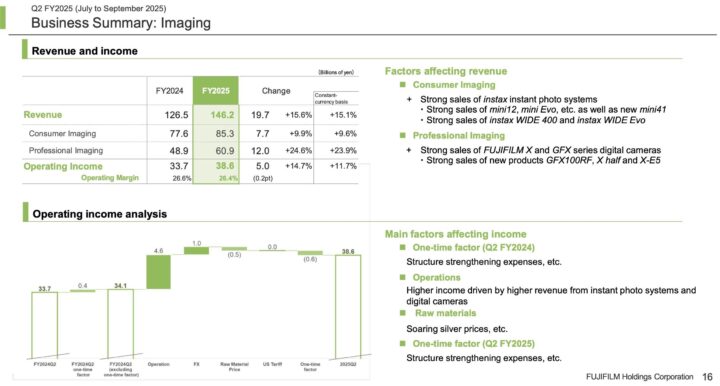
Also interesting: professional imaging (mainly X and GFX) is growing much stronger than consumer imaging (mainly Instax).
In the latest report, consumer imaging sales (mainly Instax) reached ¥77.3 billion, while professional imaging sales (mainly X and GFX) brought in ¥68 billion.
It’s quite astonishing that X/GFX sales are now making Fujifilm almost as much money as Instax sales, which the Fujifilm CEO called their new goldmine. I guess that’s a promising trend for our beloved X/GFX series.
In short:
Strong demand for instant photo systems and digital cameras drove revenue by 11.2% year-over-year to JPY145.3 billion and operating income surged by 28.4% year-over-year to JPY41.8 billion.
In the Consumer Imaging business, consistent demand for instax™ instant photo systems contributed to higher revenue.
In the Professional Imaging business, revenue growth was supported by the strong performance of the X Series and GFX Series cameras.
Fujifilm’s imaging forecast remains the same as the one issued in May 2025, with no updates in the latest report.
Fujifilm Announces Financial Results for the First Quarter Ended June 30, 2025
Fake rumors aren’t new (just now there are many more thanks to AI) —but what is new is the rise of entire ebooks written by AI, in our case Fujifilm camera guidebooks.
Some have unfortunately purchased AI-generated guides, and little it helps them if later on they leave 1 star reviews, as the damage is done and their money is gone already.
Now that these fake guides are starting to appear in the Fujifilm space too, I want to make sure you don’t fall into the trap. So let’s take a look at how to spot the fakes—and how to find real, trustworthy Fujifilm books that are actually worth your time.
To start, let’s examine one of the most recent examples: the AI-generated “guides” for the Fujifilm X-E5.
Fujifilm X-E5 Master Guide The book was published on June 18, just six days after the announcement of the X-E5. It spans hundreds of pages, produced in only a few days. The cover features a fake image of the X-E5, with the typical AI-generated flaws—like distorted lettering on the lens. So either the author has put all the effort into writing a genuine X-E5 guide by himself, but then went lazy with the cover and used an AI generated image, or the entire book is just AI generated
Fujifilm X-E5 User Guide The author claims to have used the X-E5 on assignment, yet the book’s cover features a fake, AI-generated Fujifilm camera image. Same as before: either he tells the truth and used the X-E5 and wrote the guide and only the image is AI generated, or the whole book is AI-generated
Sometimes though, it’s not as easy. For example, the cover image might show the real camera and it all looks legit at a first glance. Example:
The cover features a real X-T50, and even the reading sample—though likely AI-generated—might look convincing at first to somebody who is not very familiar with Fujifilm cameras yet.
But here’s the trick: always check the author’s background. In this case, you’ll see that Pearson C. Brooks has published dozens of “guides” in just a few days, covering all sorts of gear and topics. Unless he’s writing a book a day, it’s not unsafe to assume the content might be AI-generated. Also, by checking his other books, we can see he wrote a Leica M11 guide using a Fujifilm GFX100RF as cover image, which does not really speak for quality content curation.
There are countless examples like this out there, so please be cautious. When in doubt, do not buy.
Stick with trusted authors—those who have a proven track record, real hands-on experience with the gear, and a genuine connection to the photography community. Your time (and money) deserves better than AI fluff.
The Truly Good Stuff
In this regard, I can totally recommend Rico Pfirstinger’s Fujifilm books. But there is lots of other good stuff out there, such as: